

HISTORY
Veterinarian
The word “veterinarian” is defined as one who provides medical care to animals and comes from the Latin verb “veheri”, which means “to draw” (as in “pull”). The first known veterinary practice came about in 9000 B.C. in the Middle East. Between 4000 and 3000 B.C., in Egypt, the medical treatment of animals became more common but was still largely undeveloped. Around 1900 B.C., the first written accounts of veterinary medicine were captured in Hindu texts. Horses were the primary focus of ancient medical care because of their economic importance in transportation, agriculture, and trade. Th e first school of veterinary medicine was established in France in the 1760s and is attributed to the beginning of the scientific study of veterinary medicine. The American Veterinary Medical Association (AVMA) was organized in 1863 to promote the fi eld of veterinary medicine.
Farrier
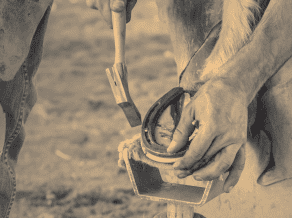
The word “farrier” is an adaptation of the French word “ferrier”, which came from the Latin root word “ferrum”, which means “iron.” Around the same time that humans discovered the domestication of the horse, they immediately understood the need to protect the horse’s feet. Evidence of the earliest forms of horseshoes can be found as early as 400 B.C., with materials ranging from plants to rawhide, with leather straps referred to as “hipposandals” used by the Romans. Horseshoes of various types were used by migratory Eurasian tribes around 200 B.C., but the practice of horseshoe making did not become widespread until the 11th century. Due to evidence attributed to the ancient practice of burying the horse with its master, we can presume that the Celts were likely the first people to protect their horses’ hooves with nailed on shoes. Th e practice of nailing on horseshoes then gradually spread through Germany, Gaul, and Britain, where there is evidence that iron shoes were used before the Roman invasion.
Specialists in the Roman army known as “immunes” included farriers, and these farriers were recognized as important Roman soldiers. The arrival of the Norman farriers had a considerable influence on farriery in Britain, and in the 13th and 14th centuries, farm horses began to be shoed. In 1356, the farriers in the city of London were called together by the mayor and first established as a fellowship. Between 1356 and 1674 the farriers in London continued to work on their craft while also providing medical care to horses. The emergence of machines capable of mass-producing horseshoes began in the 1800s. With the rise of horse riding as a sport in the early 1900s, manufactured horseshoes became a commercial success leading to the variety of commercially available horseshoes today.
EDUCATION
Veterinarian
There are currently 49 AVMA-accredited veterinary colleges. This accreditation means that these veterinary college graduates meet a competency threshold for entry into veterinary practice, as well as eligibility for professional credentialing and licensing. In the U.S., an individual may be accepted into veterinary college aft er three to four years of undergraduate education. Th e veterinary curriculum is generally a four-year program that encompasses all animal species. Internships and residencies are not required in the U.S. but are necessary if pursuing specialty board certification.
Farrier
There are approximately 20 farrier schools in the U.S., according to the American Farrier’s Association website. The length of farrier school courses ranges from two weeks to two years, but attending farrier school is not required to practice farriery in the U.S.
THE RELATIONSHIP
As with any relationship, communication is the key to a successful veterinarian-farrier relationship. It has been said that overstepping the boundaries of either profession is the most common cause for this relationship to fail. However, I have found that communication (or lack thereof) causes the most disturbance in the relationship. The common overall goal of both professions should be centered on the health of their patients. Clients and their horses are shared between veterinarians and farriers, and it
is in the best interest of the horse if these two parties work together to maintain the overall well-being of the horse. It is a reality that many veterinarians have a limited knowledge of farriery. This deficit often forces them to guess which farriery approach to recommend for specific cases. The confidence of the farrier, trainer, and owner in the equine veterinarian is easily lost if the veterinarian is perceived as unprepared or unknowledgeable. The same could also be said if the farrier is perceived as unknowledgeable or under-skilled by the veterinarian, trainer, or owner. As in many long-term relationships, veterinarian-farrier conflicts will likely arise. But resolution is often obtained with quick recognition and frank, discreet discussion about the disagreement. Mutual respect and professional behavior will most often lead to conflict resolution and relational enhancement. Effective communication between all parties—farrier, veterinarian, owner, and trainer—is essential for providing the best care for the horse and service to the owner and as well, for facilitating the professional development of the veterinarian’s and farrier’s practices.
No matter whether the veterinarian’s practice focuses primarily on elite performance horses or only partially equine in a mixed-species practice, a productive and professional relationship between the veterinarian and the local farrier community is imperative. It is always advisable to clearly discuss the proposed diagnosis and treatment plans and agree on each professional’s role in implementation on a case-by-case basis. The veterinarian should solicit and seriously consider the farrier’s input on any case and must often defer to the farrier on matters concerning fabrication and material selection of a hoof appliance, the trim of the foot, and the interval length between farriery visits. It is the veterinarian’s responsibility to acquire and maintain competence in understanding the biomechanics of the equine digit as well as familiarity with the current selection of available farriery appliances and materials. Effective and timely communication between all parties involved in the management of a case is essential to maximizing care for the patient and service to the client, as well as avoiding unnecessary misunderstandings or conflicts.
REFERENCES
1.) https://knowledge.rcvs.org.uk/heritage-and-history/history-of-theveterinary- profession
2.) Moyer, W, et al. The Equine Practitioner-Farrier Relationship: Building a Partnership. Veterinary Clinics: Equine Practice. Volume 28, Issue 1, P117-129, April 01, 2012.
3.) Moyer W, et al. The Veterinary-Farrier Relationship: Establishing and Sustaining a Mutually Beneficial Liaison. Equine Veterinary Education. Volume 30, November 2018.
4.) https://www.wcf.org.uk/history
About the Author
Brian Beasley, DVM, CJM, DWCF, DACVSMR

Dr. Brian Beasley is a Clinical Assistant Professor in the Department of Large Animal Medicine at the University of Georgia Veterinary Teaching Hospital, where he specializes in Equine Sports Medicine. Originally from southern Illinois, Dr. Beasley has recently joined Midwest Equine at Illinois as a locum veterinarian.